Insect Protein Market


Insect Protein Market Size, Share & Trends Analysis Report by Type (Crickets, Mealworms, Grasshoppers, Ants, Bees, Termites, Black Soldier Fly, and Others (Plant Hoppers, and Scale Insects)), and by Application (Food & Beverages, Animal Nutrition, Pharmaceuticals & Nutraceuticals, and Personal Care & Cosmetics), Forecast Period (2025-2035)
Industry Overview
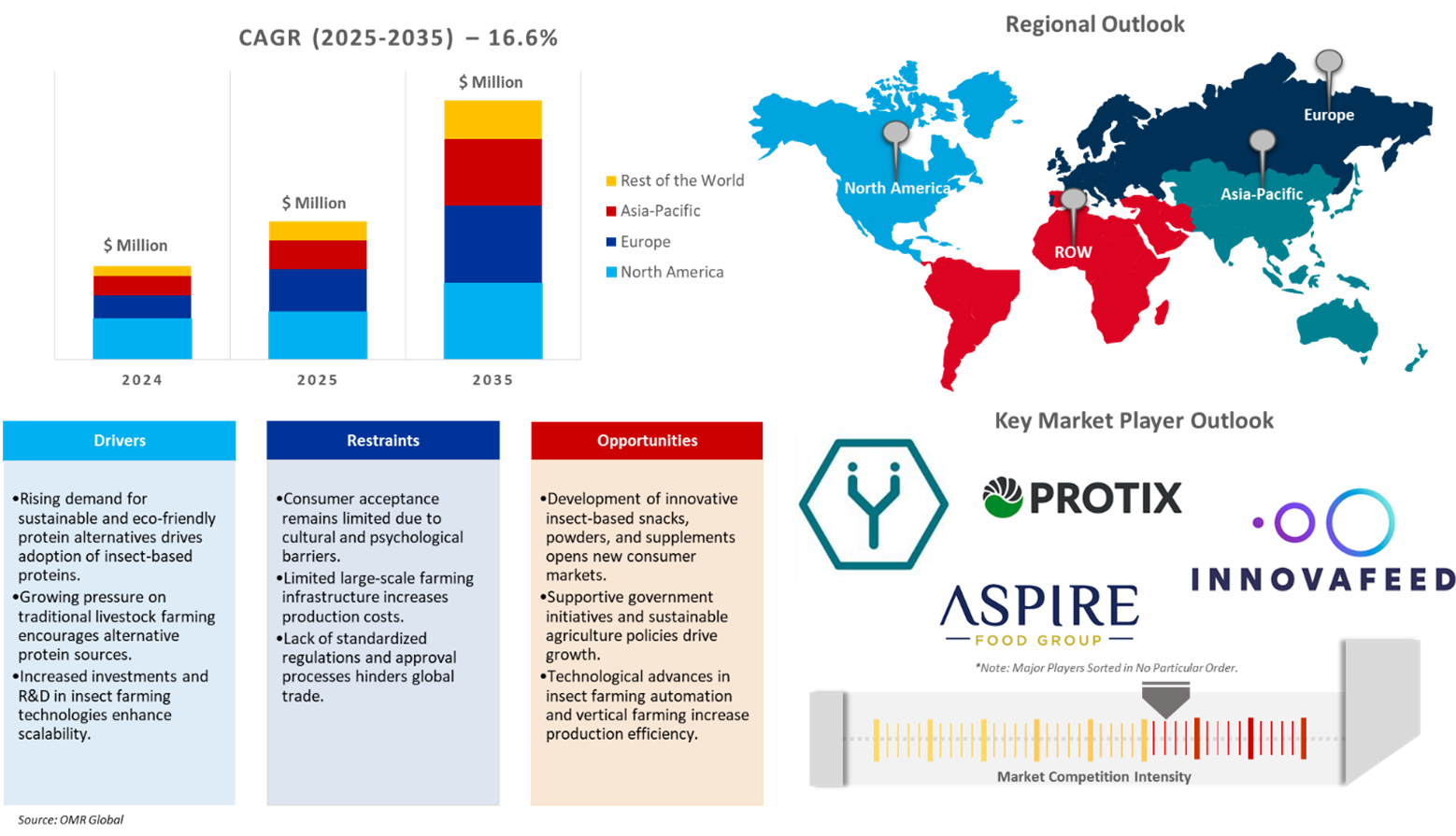
Insect protein market was valued at $510.0 million in 2024 and is projected to reach $2,754.3 million by 2035, growing at a CAGR of 16.6% during the forecast period (2025- 2035). Insect protein comes from farmed insects and is used as food for people, pets, and farm animals. It is made by drying and grinding insects such as mealworms, crickets, and black soldier fly larvae into powders or adding them to other products. It is rich in nutrition, offering a lot of protein (sometimes more than 60% of its weight), healthy fats, and minerals. Insects are farmed in ways that need less land, water, and energy than traditional livestock, making them a sustainable and cost-effective alternative.
As the global population grows and the demand for resource-efficient foods increases, insect protein is gaining attention for both human and animal nutrition. Products such as protein powders, snacks, and animal feed are becoming more common in regions such as Europe and the Asia-Pacific. For Instance, in January 2024, Ynsect received approval in the US to commercialize defatted mealworm protein for dog food, making it the first company authorized by AAFCO for this ingredient. This allows Ynsect to expand its market in North America, especially in pet food.
Market Dynamics
Technological Advancements Shaping the Insect Protein Market
Technological developments are accelerating transformation in the insect protein market by enabling large-scale, cost-effective production of insect-based food and feed. Modern insect farms now deploy automation and AI to monitor health, regulate growing environments, and boost productivity. For instance, advanced computer vision and machine learning help farmers keep track of insect growth and adjust feeding or temperature instantly, reducing waste and costs. AI-powered tools are also being used to predict yields and optimize every part of the farming process, allowing companies to produce more with fewer resources.
Market Segmentation
- Based on the type, the market is segmented into crickets, mealworms, grasshoppers, ants, bees, termites, black soldier fly, and others (plant hoppers and scale insects).
- Based on the application, the market is segmented into food & beverages, animal nutrition, pharmaceuticals & nutraceuticals, and personal care & cosmetics.
Insects, Grasshoppers, Bees, and Crickets, Dominate with a major Share
Among all insect types, the crickets, grasshoppers, and Bees segment holds the major share. These insects are favoured due to their high protein content (about 60–70% by dry weight). Crickets, in particular, are widely used for both human food (such as protein powders, snack bars, and flours) and animal feed applications. Black soldier fly and mealworms also show strong demand, especially in the animal nutrition segment.
In terms of Application, Animal Nutrition Leads the Market
The animal nutrition segment is the largest in the global insect protein market. This segment’s growth has been driven by the proven nutritional benefits and digestibility of insect proteins, as well as strong regulatory support. For Instance, major European producers such as Innovafeed have built facilities specifically dedicated to supplying animal feed. Innovafeed’s Nesle site in France can deliver up to 15,000 tons of insect protein annually, enough to feed the equivalent of 400,000 tons of fish, poultry, and pigs each year. This scale allows animal feed producers to reliably replace traditional proteins such as fishmeal and soy with sustainable insect-based alternatives.
Regional Outlook
The global insect protein market is further divided by geography, including North America (the US and Canada), Europe (the UK, Germany, France, Italy, Spain, Russia, and the Rest of Europe), Asia-Pacific (India, China, Japan, South Korea, Australia and New Zealand, ASEAN Countries, and the Rest of Asia-Pacific), and the Rest of the World (the Middle East & Africa, and Latin America).
Growing Demand for Insect Protein in the Asia-Pacific
Asia-Pacific is the fastest-growing region for the insect protein market, driven by the long-standing acceptance of insects in local diets and strong government support in countries such as South Korea, Thailand, China, and Vietnam. Modern farms and new food companies are using advanced technology to produce large amounts of insect protein, making the industry more productive and efficient. For example, Entobel in Vietnam operates the largest insect protein plant in Asia, with a capacity of 10,000 tons per year. In Malaysia, Veolia Bioconversion recently received approval to distribute insect meal and oil across the region. The increasing demand for protein-rich functional foods is further fueling growth, with more innovative products entering the market.
Market Players Outlook
The major companies operating in the global insect protein market include Aspire Food Group, Innovafeed SAS, Protix B.V., and Ynsect (SAS), among others. Market players are leveraging partnerships, collaborations, mergers, and acquisition strategies for business expansion and innovative product development to maintain their market positioning.
Recent Developments
- In March 2025, Nasekomo, a European insect farming company, introduced automated insect rearing beds, achieving a 25% feed conversion ratio in black soldier fly production. These advances help make production more efficient and cost-effective, strengthening the company’s competitive position.
The Report Covers
- Market value data analysis of 2024 and forecast to 2035.
- Annualized market revenues ($ million) for each market segment.
- Country-wise analysis of major geographical regions.
- Key companies operating in the global insect protein market. Based on the availability of data, information related to new products and relevant news is also available in the report.
- Analysis of business strategies by identifying the key market segments positioned for strong growth in the future.
- Analysis of market-entry and market expansion strategies.
- Competitive strategies by identifying ‘who-stands-where’ in the market.
1. Report Summary
• Current Industry Analysis and Growth Potential Outlook
• Global Insect Protein Market Sales Analysis – Type | Application ($ Million)
• Insect Protein Market Sales Performance of Top Countries
1.1. Research Methodology
• Primary Research Approach
• Secondary Research Approach
1.2. Market Snapshot
2. Market Overview and Insights
2.1. Scope of the Study
2.2. Analyst Insight & Current Market Trends
2.2.1. Key Insect Protein Market Industry Trends
2.2.2. Market Recommendations
2.3. Porter's Five Forces Analysis for the Insect Protein Market
2.3.1. Competitive Rivalry
2.3.2. Threat of New Entrants
2.3.3. Bargaining Power of Suppliers
2.3.4. Bargaining Power of Buyers
2.3.5. Threat of Substitutes
3. Market Determinants
3.1. Market Drivers
3.1.1. Drivers For Global Insect Protein Market: Impact Analysis
3.2. Market Pain Points and Challenges
3.2.1. Restraints For Global Insect Protein Market: Impact Analysis
3.3. Market Opportunities
3.3.1. Opportunities For Global Insect Protein Market: Impact Analysis
4. Competitive Landscape
4.1. Competitive Dashboard – Insect Protein Market Revenue and Share by Manufacturers
• Insect Protein Product Comparison Analysis
• Top Market Player Ranking Matrix
4.2. Key Company Analysis
4.2.1. Aspire Food Group
4.2.1.1. Overview
4.2.1.2. Product Portfolio
4.2.1.3. Financial Analysis (Subject to Data Availability)
4.2.1.4. SWOT Analysis
4.2.1.5. Business Strategy
4.2.2. Innovafeed SAS
4.2.2.1. Overview
4.2.2.2. Product Portfolio
4.2.2.3. Financial Analysis (Subject to Data Availability)
4.2.2.4. SWOT Analysis
4.2.2.5. Business Strategy
4.2.3. Protix B.V.
4.2.3.1. Overview
4.2.3.2. Product Portfolio
4.2.3.3. Financial Analysis (Subject to Data Availability)
4.2.3.4. SWOT Analysis
4.2.3.5. Business Strategy
4.2.4. Ynsect (SAS)
4.2.4.1. Overview
4.2.4.2. Product Portfolio
4.2.4.3. Financial Analysis (Subject to Data Availability)
4.2.4.4. SWOT Analysis
4.2.4.5. Business Strategy
4.3. Top Winning Strategies by Market Players
4.3.1. Merger and Acquisition
4.3.2. Product Launch
4.3.3. Partnership And Collaboration
5. Global Insect Protein Market Sales Analysis by Type ($ Million)
5.1. Crickets
5.2. Mealworms
5.3. Grasshoppers
5.4. Ants
5.5. Bees
5.6. Termites
5.7. Black Soldier Fly
5.8. Others (Plant Hoppers, and Scale Insects)
6. Global Insect Protein Market Sales Analysis by Application ($ Million)
6.1. Food & Beverages
6.2. Animal Nutrition
6.3. Pharmaceuticals & Nutraceuticals
6.4. Personal Care & Cosmetics
7. Regional Analysis
7.1. North American Insect Protein Market Sales Analysis – Type | Application | Country ($ Million)
• Macroeconomic Factors for North America
7.1.1. United States
7.1.2. Canada
7.2. European Insect Protein Market Sales Analysis – Type | Application | Country ($ Million)
• Macroeconomic Factors for Europe
7.2.1. UK
7.2.2. Germany
7.2.3. Italy
7.2.4. Spain
7.2.5. France
7.2.6. Russia
7.2.7. Rest of Europe
7.3. Asia-Pacific Insect Protein Market Sales Analysis – Type | Application | Country ($ Million)
• Macroeconomic Factors for Asia-Pacific
7.3.1. China
7.3.2. Japan
7.3.3. South Korea
7.3.4. India
7.3.5. Australia & New Zealand
7.3.6. ASEAN Countries (Thailand, Indonesia, Vietnam, Singapore, And Other)
7.3.7. Rest of Asia-Pacific
7.4. Rest of the World Insect Protein Market Sales Analysis – Type | Application | Country ($ Million)
• Macroeconomic Factors for Rest of the World
7.4.1. Latin America
7.4.2. Middle East and Africa
8. Company Profiles
8.1. Agronutris
8.1.1. Quick Facts
8.1.2. Company Overview
8.1.3. Product Portfolio
8.1.4. Business Strategies
8.2. All Things Bugs, LLC
8.2.1. Quick Facts
8.2.2. Company Overview
8.2.3. Product Portfolio
8.2.4. Business Strategies
8.3. Aspire Food Group
8.3.1. Quick Facts
8.3.2. Company Overview
8.3.3. Product Portfolio
8.3.4. Business Strategies
8.4. Beta Hatch
8.4.1. Quick Facts
8.4.2. Company Overview
8.4.3. Product Portfolio
8.4.4. Business Strategies
8.5. Bioflytech
8.5.1. Quick Facts
8.5.2. Company Overview
8.5.3. Product Portfolio
8.5.4. Business Strategies
8.6. Chapul Farms
8.6.1. Quick Facts
8.6.2. Company Overview
8.6.3. Product Portfolio
8.6.4. Business Strategies
8.7. Entobel Ba Ria – Vung Tau Co. Ltd.
8.7.1. Quick Facts
8.7.2. Company Overview
8.7.3. Product Portfolio
8.7.4. Business Strategies
8.8. Entomo Farms
8.8.1. Quick Facts
8.8.2. Company Overview
8.8.3. Product Portfolio
8.8.4. Business Strategies
8.9. EnviroFlight (Darling Ingredients Inc.)
8.9.1. Quick Facts
8.9.2. Company Overview
8.9.3. Product Portfolio
8.9.4. Business Strategies
8.10. Flylab Tech Co., Ltd.
8.10.1. Quick Facts
8.10.2. Company Overview
8.10.3. Product Portfolio
8.10.4. Business Strategies
8.11. Global Bugs Asia Co., Ltd.
8.11.1. Quick Facts
8.11.2. Company Overview
8.11.3. Product Portfolio
8.11.4. Business Strategies
8.12. Grubbly Farms
8.12.1. Quick Facts
8.12.2. Company Overview
8.12.3. Product Portfolio
8.12.4. Business Strategies
8.13. Hexafly
8.13.1. Quick Facts
8.13.2. Company Overview
8.13.3. Product Portfolio
8.13.4. Business Strategies
8.14. Innovafeed SAS
8.14.1. Quick Facts
8.14.2. Company Overview
8.14.3. Product Portfolio
8.14.4. Business Strategies
8.15. Protenga Pte Ltd
8.15.1. Quick Facts
8.15.2. Company Overview
8.15.3. Product Portfolio
8.15.4. Business Strategies
8.16. Protix B.V.
8.16.1. Quick Facts
8.16.2. Company Overview
8.16.3. Product Portfolio
8.16.4. Business Strategies
8.17. Sentara Group
8.17.1. Quick Facts
8.17.2. Company Overview
8.17.3. Product Portfolio
8.17.4. Business Strategies
8.18. Symton Inc
8.18.1. Quick Facts
8.18.2. Company Overview
8.18.3. Product Portfolio
8.18.4. Business Strategies
8.19. Ynsect (SAS)
8.19.1. Quick Facts
8.19.2. Company Overview
8.19.3. Product Portfolio
8.19.4. Business Strategies
1. Global Insect Protein Market Research and Analysis By Type, 2024-2035 ($ Million)
2. Global Crickets Protein Market Research and Analysis By Region, 2024-2035 ($ Million)
3. Global Mealworms Protein Market Research and Analysis By Region, 2024-2035 ($ Million)
4. Global Grasshoppers Protein Market Research and Analysis By Region, 2024-2035 ($ Million)
5. Global Ants Protein Market Research and Analysis By Region, 2024-2035 ($ Million)
6. Global Bees Protein Market Research and Analysis By Region, 2024-2035 ($ Million)
7. Global Termites Protein Market Research and Analysis By Region, 2024-2035 ($ Million)
8. Global Black Soldier Fly Protein Market Research and Analysis By Region, 2024-2035 ($ Million)
9. Global Others Insect Protein Market Research and Analysis By Region, 2024-2035 ($ Million)
10. Global Insect Protein Market Research and Analysis By Application, 2024-2035 ($ Million)
11. Global Insect Protein For Food & Beverages Market Research and Analysis By Region, 2024-2035 ($ Million)
12. Global Insect Protein For Animal Nutrition Market Research and Analysis By Region, 2024-2035 ($ Million)
13. Global Insect Protein For Pharmaceuticals & Nutraceuticals Market Research And Analysis By Region, 2024-2035 ($ Million)
14. Global Insect Protein For Personal Care & Cosmetics Market Research And Analysis By Region, 2024-2035 ($ Million)
15. Global Insect Protein Market Research and Analysis By Region, 2024–2035 ($ Million)
16. North American Insect Protein Market Research and Analysis By Country, 2024–2035 ($ Million)
17. North American Insect Protein Market Research and Analysis By Type, 2024–2035 ($ Million)
18. North American Insect Protein Market Research and Analysis By Application, 2024–2035 ($ Million)
19. European Insect Protein Market Research and Analysis By Country, 2024–2035 ($ Million)
20. European Insect Protein Market Research and Analysis By Type, 2024–2035 ($ Million)
21. European Insect Protein Market Research and Analysis By Application, 2024–2035 ($ Million)
22. Asia-Pacific Insect Protein Market Research and Analysis By Country, 2024–2035 ($ Million)
23. Asia-Pacific Insect Protein Market Research and Analysis By Type, 2024–2035 ($ Million)
24. Asia-Pacific Insect Protein Market Research and Analysis By Application, 2024–2035 ($ Million)
25. Rest of the World Insect Protein Market Research and Analysis By Region, 2024–2035 ($ Million)
26. Rest of the World Insect Protein Market Research and Analysis By Type, 2024–2035 ($ Million)
27. Rest of the World Insect Protein Market Research and Analysis By Application, 2024–2035 ($ Million)
1. Global Insect Protein Market Share Analysis By Type, 2024 Vs 2035 (%)
2. Global Crickets Protein Market Share Analysis By Region, 2024 Vs 2035 (%)
3. Global Mealworms Protein Market Share Analysis By Region, 2024 Vs 2035 (%)
4. Global Grasshoppers Protein Market Share Analysis By Region, 2024 Vs 2035 (%)
5. Global Ants Protein Market Share Analysis By Region, 2024 Vs 2035 (%)
6. Global Bees Protein Market Share Analysis By Region, 2024 Vs 2035 (%)
7. Global Termites Protein Market Share Analysis By Region, 2024 Vs 2035 (%)
8. Global Black Soldier Fly Protein Market Share Analysis By Region, 2024 Vs 2035 (%)
9. Global Others Insect Protein Market Share Analysis By Region, 2024 Vs 2035 (%)
10. Global Insect Protein Market Share Analysis By Application, 2024 Vs 2035 (%)
11. Global Insect Protein For Food & Beverages Market Share Analysis By Region, 2024 Vs 2035 (%)
12. Global Insect Protein For Animal Nutrition Market Share Analysis By Region, 2024 Vs 2035 (%)
13. Global Insect Protein For Pharmaceuticals & Nutraceuticals Market Share Analysis By Region, 2024 Vs 2035 (%)
14. Global Insect Protein For Personal Care & Cosmetics Market Share Analysis By Region, 2024 Vs 2035 (%)
15. Global Insect Protein Market Share By Region, 2024 Vs 2035 (%)
16. US Insect Protein Market Size, 2024–2035 ($ Million)
17. Canada Insect Protein Market Size, 2024–2035 ($ Million)
18. UK Insect Protein Market Size, 2024–2035 ($ Million)
19. France Insect Protein Market Size, 2024–2035 ($ Million)
20. Germany Insect Protein Market Size, 2024–2035 ($ Million)
21. Italy Insect Protein Market Size, 2024–2035 ($ Million)
22. Spain Insect Protein Market Size, 2024–2035 ($ Million)
23. Russia Insect Protein Market Size, 2024–2035 ($ Million)
24. Rest of Europe Insect Protein Market Size, 2024–2035 ($ Million)
25. India Insect Protein Market Size, 2024–2035 ($ Million)
26. China Insect Protein Market Size, 2024–2035 ($ Million)
27. Japan Insect Protein Market Size, 2024–2035 ($ Million)
28. South Korea Insect Protein Market Size, 2024–2035 ($ Million)
29. Australia and New Zealand Insect Protein Market Size, 2024–2035 ($ Million)
30. ASEAN Economies Insect Protein Market Size, 2024–2035 ($ Million)
31. Rest of Asia-Pacific Insect Protein Market Size, 2024–2035 ($ Million)
32. Latin America Insect Protein Market Size, 2024–2035 ($ Million)
33. Middle East and Africa Insect Protein Market Size, 2024–2035 ($ Million)
- Printable version
- No restriction to number of users within the company

